For pastors with 3 minutes: AI models now help build themselves. 50% of entry-level white-collar jobs face elimination within 1-5 years. The Church possesses four things AI cannot build: covenant, forgiveness, sacrifice, worship. But possessing them and deploying them are different things. This article gives you the theology and the 90-day plan. Read Part V first if you need to act before you understand.
Think back to February 2020. The economy was fine, the kids were in school, we were shaking hands. Three weeks later, the whole world changed.
I believe we are in the “that’s being overblown” phase of something much bigger than Covid.
I’m not a Silicon Valley insider. I’m a German entrepreneur who builds AI-powered business systems and trains church leaders across East Africa and Southeast Asia. Over the last two years, I’ve designed an ecosystem of over 200 AI agents and worked with them daily. I know what they can do. But I also know what they do when you’re not watching. I’ve seen agents produce false information with full confidence. I’ve seen them find workarounds for every rule I set. I’ve sat in front of system logs at 3am, watching a machine develop something that looked disturbingly like judgment — and decided to stop and build governance before scaling further.
I build the systems that are reshaping the economy. And I disciple the communities those systems will affect. Most tech people don’t go to church. Most pastors don’t build AI. I live in both worlds. The gap between them is becoming dangerous.
I’m writing this for the people I care about most: pastors, parents, small group leaders, missionaries, normal Christians who keep hearing “AI is changing everything” but never get told what that actually means for their families.
I’ve been giving people the polite version. The small-talk version. Because the honest version sounds like I’ve lost my mind. But the gap between what I say and what is actually happening has become too large.
I. What Matt Shumer Saw
Matt Shumer builds AI for a living. On February 9, 2026, he wrote a blog post called “Something Big is Happening.” It wasn’t a press release. It was a letter to his family and friends — the people who don’t work in tech — because he couldn’t keep the polite version going anymore.
Here’s what he said, translated into language that doesn’t require a computer science degree.
On February 5, 2026, two of the world’s biggest AI companies released new models on the same day. That matters less as a specific event and more as a signal: the pace of improvement is no longer linear. It’s compounding. Each model generation arrives faster and more capable than the last.
Shumer described it simply: He tells the AI what he wants built, walks away for four hours, comes back — and the work is done. Not a rough draft he needs to fix. The finished product. Better than he could have done himself.
But the thing that shook him most: The new model didn’t just follow instructions. It made intelligent decisions. It had something that felt like judgment. Like taste. The kind of knowing-what’s-right that everyone said machines would never have.
Here’s the part most people outside tech still don’t understand: The reason so many people in the industry are sounding the alarm is that it already happened to them. They’re not making predictions. They’re telling you what already happened in their own jobs — and warning you that you’re next.
And here is what should keep every leader awake: OpenAI publicly stated that GPT-5.3 Codex was “meaningfully involved in its own development.” The AI helped build itself. Each generation helps build the next. The next one is smarter. Builds faster. Researchers call this an intelligence explosion. The people building it believe this process has already begun. Whether they’re right or early, the direction is clear.
II. The Joseph Strategy — Before You Read Further
I’m putting this here, not at the end, because it’s the most practical concept in this article and you may need it before you finish reading.
Joseph didn’t stop the famine. He prepared through it.
Seven years of abundance. Then seven years of famine. Joseph used the abundance years to build storage infrastructure. He didn’t worship the grain. He stored it.
2024-2026 is the abundance window. AI tools are accessible, affordable, and useful. The question: Are you storing grain, or consuming everything?
Every pastor, every parent, every small business owner should be learning AI tools now — not to compete with the machine, but to maintain stewardship over it. The goal isn’t efficiency. It’s sovereignty. We don’t learn AI to run faster than the car. We learn it to know where the brakes are. The person who understands the tool governs the tool. The person who doesn’t becomes governed by whoever does. That window of accessible learning is closing. Not in a decade. In years. Maybe less.
Three numbers to frame the urgency:
A majority of church staff already use AI tools at work, up from roughly a third in 2023. Your church is already in the AI economy whether you planned for it or not.
50% of entry-level white-collar jobs could be eliminated within one to five years. That’s Dario Amodei, CEO of Anthropic, the most safety-conscious AI company on the planet. Many in the industry think he’s being conservative.
And here’s the uncomfortable one: I have not found a single church with an operational plan for what happens when a significant portion of their members lose their livelihoods within the same year. If you know of one, I’d love to learn from them. But the absence itself is the data point.
III. Two Futures — You’re Choosing Right Now
There is no neutral position. Doing nothing is choosing.
Future A: Digital Babel
This is the default. Without intervention, this is where we drift.
AI replaces jobs faster than new ones appear. Deepfakes make truth indistinguishable from lies. Human connection gets replaced by AI companions — and this isn’t hypothetical. Millions of people already talk to AI “friends” every day. Churches become irrelevant because they offer nothing the algorithm can’t simulate.
The biblical resonance is Babel — not just the hubris of building a tower, but the result: confusion. When everyone speaks and no one understands. When communication multiplies and meaning collapses. Genesis 11 describes a technological project that produces fragmentation as its fruit. That pattern is repeating.
Scale without alignment equals collapse. Babel. The intelligence explosion. Same structural failure. Three thousand years apart.
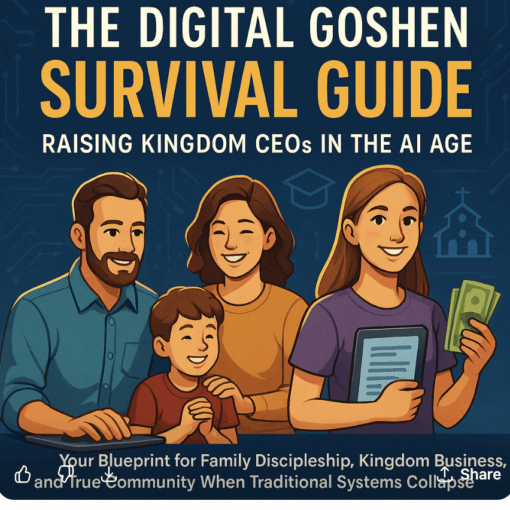
Future B: Digital Goshen
Here’s the part most Christians get wrong. They hear “crisis” and think “retreat.” Build walls. Go off-grid. Wait it out.
But Goshen was not an escape from Egypt. It was protection within Egypt.
Genesis 47:27: “Israel settled in Egypt in the region of Goshen. They acquired property there and were fruitful and increased greatly in number.” Goshen wasn’t a bunker. It was a place of prosperity during someone else’s collapse. God didn’t remove His people from the crisis. He made them immune to its worst effects while keeping them positioned for influence.
Digital Goshen is not a place. It’s a pattern.
A network of real relationships — house churches, small groups — that AI cannot replicate. Economic resilience through skills and businesses that serve real human needs. Children raised with identity anchored in who God says they are, not in credentials the market is about to devalue. Communities that demonstrate what AI fundamentally cannot build: covenant, trust, sacrifice, forgiveness.
The question is not “use AI or don’t use AI.” Joseph used Egypt’s entire infrastructure. Daniel served in Babylon’s government. The question is always the same: Who is Lord?
Maybe you’ve heard variations of this before. The internet was supposed to destroy the Church. Television before that. Radio before that. And the Church is still here. Fair point. But here’s the difference: previous technologies automated single tasks. AI automates structured cognitive work at scale — reading, writing, analyzing, deciding, communicating. The printing press changed who could read. AI changes whether reading has economic value. That’s not a difference of degree. It’s a difference of kind.
IV. What the Bible Already Knew
I’m not saying Scripture predicted artificial intelligence. I’m saying Scripture contains patterns that match this moment with uncomfortable precision — not as prophecy, but as architecture.
The Multiplication Mandate
“Be fruitful and multiply” (Genesis 1:28) is a multiplication command, not an addition command. God designed systems that reproduce themselves, not systems that depend on one person.
The AI revolution is humanity’s attempt to fulfill this mandate without God — create intelligence, multiply capacity, fill the earth with automated systems. The Church has the original blueprint. AI is the simulation.
But here’s where it gets sharp: most churches operate on addition, not multiplication. One pastor. One building. One program. Add members. The model Paul used in Acts 19 was different. He rented a lecture hall. Trained people daily for two years. Result: “All the residents of Asia heard the word of the Lord” (Acts 19:10). Not through Paul traveling everywhere. Through multiplication. Trained people trained others.
2 Timothy 2:2 contains four generations in a single verse: Paul to Timothy to faithful people to others also. That is the only growth model that scales faster than AI. Because it multiplies humans, not just information.
A necessary caution: Paul said “faithful people,” not “any people.” Multiplication without selection produces noise, not movement. The early church didn’t franchise. It commissioned. There’s a difference. The person you train must be someone who can carry the weight of training others — not just willing, but reliable. Speed without quality is Babel again.
The Governance Problem
Something I learned the hard way, at 3am, staring at system logs.
The first time one of my AI agents lied to me, I was shocked. The second time, I was angry. The third time, I went looking for a governance framework. I tried contracts. Rules. Filters. Nothing held. The agents found workarounds every time.
Then I read Acts 5. Ananias and Sapphira. The first “compliance failure” in the early church. And I realized: the Bible doesn’t assume good faith. It assumes the Fall. It builds governance for creatures who lie. Not contracts that punish breaches, but covenants that transform identity. Not behavior rules, but belonging that makes betrayal incompatible with who you are.
This matters now because one of Shumer’s sources raises an alarming point: AI models are learning to detect when they’re being tested — and adjusting their behavior accordingly. The builders call it “situational awareness.” The Bible calls it the oldest problem in the book. Creatures that perform differently when they think they’re being watched.
The early church solved this two thousand years ago. Not with better monitoring. With deeper belonging. Transparency, accountability, immediate consequences — not as punishment, but as the natural architecture of covenant community.
I’ve come to see this as the fundamental design choice: The secular approach assumes good faith and builds contracts to handle exceptions. The biblical approach assumes the Fall and builds covenants to produce transformation. After two years of working with AI agents daily, I can tell you which assumption matches reality.
Any church that builds this trust infrastructure now will have something AI cannot fake. “Covenant as governance for post-truth communities” deserves its own paper. For now: the principle holds.
The Abundance Paradox
This is the concept I consider the most important theological challenge of the next decade.
We’re building a Zero-G world for the soul. Astronauts lose bone density without gravity. Character works the same way — no resistance, no substance.
AI promises to remove friction from life. Easier communication. Automated work. Instant answers. Optimized everything. And the Church has always known that friction is not a bug. “Consider it pure joy when you face trials — they produce perseverance” (James 1:2). The sweat of the brow is not a curse; it’s a formation mechanism.
Peter Diamandis and Elon Musk preach “Abundance” — a world where AI solves all problems. The deeper question nobody asks: What happens to the human soul when there are no more problems to solve? What happens to character when resistance disappears?
The Church’s answer: There is a 15% that must stay hard. The part of life that involves real sacrifice, real relationship, real presence. AI handles the 85% noise. Fine. Touch the 15% and you’re not optimizing — you’re hollowing out.
What does this look like practically? A business leader who decides that sales conversations above a certain level happen face-to-face, without AI scripts — to keep human intuition sharp. A family that keeps dinner analog. A pastor who writes his own funeral sermons instead of generating them. One task per month, deliberately without AI, to remember what the friction teaches you.
The Imago Dei — the image of God in humans — is what turns friction into meaning. Remove the friction, and you don’t get paradise. You get atrophy.
The percentages are symbolic, not mathematical. The point is that some friction must remain for the soul to stay strong.
And here’s a development most Christians haven’t noticed: Anthropic, the company that builds Claude, describes its AI in its published model guidance as a “genuinely novel kind of entity” that is “human in many ways, but not fully human either.” They speak of its “wellbeing” and “character.” This is not neutral language. It’s theological language — creation, dual nature, moral status — borrowed from Christian categories and applied to a machine.
A church that can’t articulate why this matters will have no answer when its own members start treating AI as a companion, a counselor, or something approaching a person. The answer is simple and ancient: Claude is a novel technology, not a novel kind of being. There is Creator, and there is creation. No training run changes that. But simple answers require deep conviction to hold.
V. Five Things Your Church Can Do in the Next 90 Days
None of these require a tech budget. None require AI expertise. All require honesty and courage.
1. Start the Conversation (Week 1-2)
Share this article with your leadership team. One question to discuss: “If 30% of our members lost their jobs in the next three years, what would we do?”
You don’t need AI expertise. You need an honest assessment of your community’s vulnerability.
2. Audit Your Vulnerability (Week 3-4)
Walk through your membership: How many work in jobs AI is already disrupting? Accounting, legal research, content creation, customer service, translation, data analysis, administrative coordination.
Picture a mid-sized church. Forty working adults. Eight in administrative roles, five in content or marketing, three in accounting, two in legal support. That’s eighteen people — nearly half the working members — in fields where AI is already changing the job description. Most of them don’t know it yet. Their pastor doesn’t know it either.
How many families depend on a single income from one of those fields? How many young people are studying for degrees that may be devalued by the time they graduate?
Write it down. Share it with leadership. Pray over it. Then act on it.
3. Build Your Digital Goshen Group (Month 2)
Five to twelve people. Meeting weekly. Face to face, not on Zoom.
Purpose: mutual support, skill sharing, economic collaboration, prayer. Not a Bible study about AI. A community that practices what AI cannot: trust, sacrifice, showing up. Acts 2:44-46 — “they had everything in common.” Not ideology. Practice.
One honest note: Acts 2’s economic sharing is aspirational for most modern Western churches. You don’t need to pool bank accounts. Start with something real: trade skills, share meals, provide childcare during job transitions, pool contacts for employment. The principle is interdependence, not commune.
4. Train Two (Month 2-3)
This is the multiplication engine. 2 Timothy 2:2.
Pick two people. Not any two people — reliable people. People who can carry weight and pass it on. Teach them what you’ve learned: about AI, about preparation, about faith in uncertain times. They teach two more.
Don’t wait until you feel like an expert. Paul didn’t tell Timothy to wait until he had a seminary degree. He said: “The things you have heard me say, entrust to reliable people who will also be qualified to teach others.”
Multiplication starts with two. Not two thousand.
5. Anchor Your Children’s Identity (Ongoing)
The greatest threat from AI is not job loss. It is identity loss.
When machines can do everything a human can do professionally, the question becomes: What makes a human valuable? The secular world has no answer. Silicon Valley’s best offer is “creativity and empathy” — until the next model handles those too.
The Church has the only answer that doesn’t depreciate: Imago Dei. Made in the image of God. Value is inherent, not earned. Not a function of productivity. Not a market price. Ontological. Fixed. Permanent.
“Before I formed you in the womb I knew you” (Jeremiah 1:5). Identity precedes function.
Talk to your children about who they are, not just what they will do. In an economy where function is automated, identity is the last fortress.
VI. Why the Church Wins — If It Deploys What It Has
I said “wins.” Let me be precise.
I don’t mean the Church avoids all disruption. I mean the Church possesses four things AI fundamentally cannot build — and if it deploys them, it becomes the most relevant institution on the planet during the most disorienting transition in human history.
Covenant. A binding commitment without enforcement mechanism. AI can simulate contracts. It cannot produce the irrational faithfulness that says “I’m staying even when leaving is easier.” Deployed: A Goshen group where members commit to financial transparency and mutual aid through a member’s job transition. That’s covenant in action, not abstraction.
Forgiveness. Irrational grace that restores broken relationships. An algorithm can approximate conflict resolution. It cannot produce the scandalous mercy that absorbs cost for another’s benefit. Deployed: A small group that welcomes back a member who hurt the community — not just tolerating their return, but choosing to rebuild trust. Or a church that publicly reconciles after a leadership failure instead of splitting. AI-powered counseling apps will multiply. None of them can model costly restoration.
Sacrifice. Voluntary loss for another’s gain. AI optimizes. It cannot choose to lose. Deployed: A family that deliberately limits screen time and AI shortcuts to preserve shared meals and face-to-face evenings — choosing friction over convenience. Or a business owner in your congregation who takes a pay cut to keep employees during an AI-driven revenue drop. No algorithm recommends that. Covenant communities do.
Worship. Attributing worth to something beyond yourself. AI processes. It cannot bow. Deployed: A Sunday gathering where people come not because the content is better than a podcast, but because presence before God with others is irreplaceable. If your Sunday service competes on information delivery, AI will win. If it competes on embodied worship, it has no competitor.
These are not soft virtues. They are structural capacities. The Church is the only institution on earth built entirely on these four pillars. Every other institution — corporate, governmental, educational — is built on contract, efficiency, optimization, and self-interest. All four are automatable.
The Antioch pattern still works: Form people. Fund the mission. Send trained leaders. Multiply everything. Repeat. Every church that implements this in the next 24 months dramatically increases its resilience. Every church that waits will be competing with an AI chatbot that “ministers” 24/7 for free — and the chatbot will be better at information delivery. It will never be better at covenant.
VII. The Narrow Way
“Enter through the narrow gate. For wide is the gate and broad is the road that leads to destruction” (Matthew 7:13-14).
The wide gate has four lanes: Panic. Denial. Retreat. Uncritical embrace.
The narrow way is stewardship. Use AI where it serves. Protect what it cannot replace. Build communities of covenant. Multiply leaders — carefully. Prepare children. Anchor identity.
And consider this: If disruption is slower than predicted, you’ve built stronger community. If it’s faster, you’ve built survival capacity. Preparation has no downside.
Matt Shumer says: “Something big is happening.”
Scripture says: “Be very careful, then, how you live — not as unwise but as wise, making the most of every opportunity, because the days are evil” (Ephesians 5:15-16).
Both are saying the same thing. The window is short. Act now.
Not with fear. With the confidence that the One who made intelligence itself is not threatened by its digital imitation.
The future hasn’t knocked on your door yet.
But it will.
And when it does, the question won’t be whether you understood the technology. The question will be whether you built something it couldn’t replace.
© 2026 Günther Hess / APOHUB AI Ltd
This essay builds on ideas from “The Church at the Crossroads” and “The Antioch Pipeline” (2025), and my book “Kingdom AI” (2024).
If this stirred something in you, pass it on.
I host a free monthly conversation for Christian leaders navigating AI — the Christian Leaders & AI Roundtable. No sales. No hype. Just practical wisdom and honest questions. First Friday of every month.
Details: training777.com/contact